



PRODUCTHEAD is a regular newsletter of product management goodness,
curated by Jock Busuttil.
killer product #
every PRODUCTHEAD edition is online for you to refer back to
tl;dr
The SaaSpocalypse won’t kill off vendors, but they will have to change their pricing strategy
There is an opportunity to exploit higher usage driven by AI agents and increased automation
hello
It’s always fun when someone coins a catchy name for a sudden market correction. Usually it has to overstate the case because sowing fear, uncertainty and doubt is an easy if unconscionable tactic to appease the content creation algorithm. The Great Flattening was one: layoffs mainly affecting middle management under the guise of AI-driven efficiency, but in reality more a correction after several years of over-hiring during zirp (zero interest rate policy).
Another recent example is the SaaSpocalypse. Depending on whose clickbait-y articles you’re reading, the SaaSpocalypse is either yet to come, or has already been and gone.

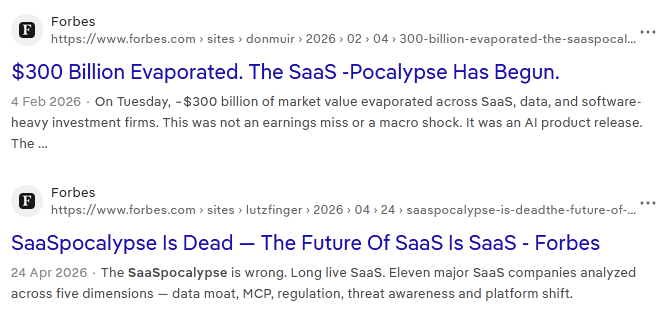
It refers a sudden downturn in early 2026 in the share prices of companies providing software as a (subscription) service. The main reason for the sharp drop was the fear of anticipated disruption caused by a single AI agent being able to fulfil various and diverse tasks that until then had needed multiple humans, each with their own SaaS subscription. As an added concern, AI also threatened their lucrative revenue streams from plugins and professional services (bespoke tailoring of workflow and capability) because in theory customers could now roll their own far more easily. Almost overnight, AI agents had seemingly broken the traditional SaaS business model, and the stock markets reacted accordingly.
Now, when commentators start calling something an apocalypse, they’re usually trying to conjure up visions of a barren wasteland in the aftermath of some cataclysmic event. It’s probably intended along the lines of James Cameron’s Terminator franchise – not least because of the facile subtext (mankind’s hubris in creating a powerful AI that pegged them as the problem in the first place). Seeking to out-do each other, the hot takes became hotter and spicier, making it sound as if the collapse of Salesforce, ServiceNow and others like them was a foregone conclusion. (Spoiler alert: it isn’t, they’ll adapt.)
Because I’m contractually required to crowbar in a Classics reference every now and again, I like that there’s a more literal meaning to SaaSpocalypse, which I’m sure was wholly unintentional. The the word ‘apocalypse’ originally comes from the Ancient Greek ἀποκάλυψις (apokálupsis), literally ‘an unveiling’ of something previously hidden or not known. To my mind, this inadvertently reflects what has actually happened.
The big reveal was the extent to which software pricing is predicated on assumptions, in this case that the product needs to be driven by a human being. APIs and automation are by no means new, however the big SaaS companies have been relying for ages on the assumption that their enterprise workflows were too complex to be automated fully, and so needed a human in the mix. And while humans were the rate-determining step, they acted as a proxy measure for the size of company and their software usage, so the SaaS companies exploited that constraint by pricing their software per seat.
AI disrupted that business model assumption and caught companies on the hop. But does that mean that SaaS companies are doomed to be crushed under the foot of AI agents?


No, of course not. Enterprise SaaS customers have too much of their corporate workflow tied into these SaaS platforms to up sticks – the cost and friction of such a change is still prohibitive, particularly while AI literacy is still not deep or widespread for many.
However, some business model innovation needs to happen, particularly around pricing. Only the truly stubborn or glacial companies will really be left behind. Everyone else is going to find a new proxy for value and size of company to replace the per-seat model. And I bet that the SaaS companies will come out richer as a result.
For you this week #
In a recent talk for Productized 2026, Emanuel Martonca describes how traditional units of pricing and billing cycles often fail to reflect the needs of the buyer and what they value. The units vendors choose effectively dictate their market positioning – their customers will compare them with other similar vendors that price their offerings with the same units. Pricing strategy has been disrupted, so expect innovation in that space.
The editorial team at Paddle also feel the SaaSpocalypse has been blown out of proportion. AI agents represent a new channel for distribution, and are driving far greater levels of usage and productivity than human users could ever generate. It’s inevitable that SaaS companies will capitalise on this.
Speak to you soon,
Jock
what to think about this week
Pricing in the Age of SaaSpocalypse
The software market is in turmoil. SaaS growth is decelerating, stock prices are tanking, and everyone’s blaming AI. But the real story is more complicated. Most SaaS companies built pricing models that only worked during a specific economic moment: cheap capital, aggressive expansion, customers who renewed automatically.
In this talk, Emanuel Martonca, Pricing Engineer & Founder of Soft Fight, dives into the debate of, with all these changes, what to do now.
[VIDEO] I see you with your classic X-Men reference
[Emanuel Martonca / Productized]

Why the ‘SaaS-Pocalypse’ isn’t the end of SaaS – and how to win in the AI era
Every generation of software has its ‘apocalypse’ moment.
Today, we’re watching the same pattern unfold again. The so-called ‘SaaS-Pocalypse’ isn’t the death of SaaS. It’s the repricing of outdated revenue assumptions in the age of AI.
Pricing disruption means pricing innovation
[Paddle]
recent posts
How to form a go-to-market strategy
A go-to-market strategy isn’t something you tack on as an afterthought to an upcoming product launch. Instead it’s about understanding where value exchanges occur, and figuring out how to make them more frequent, consistent and predictable.
Go-to-market emerges from your discovery
[I Manage Products]
We’re all addicted to AI, but it’s going to be okay
We seem to stuck in a contradiction in which we worry about AI’s effect on our critical thinking, while finding it equally hard to resist using. Why is that?
[I Manage Products]
Canary in the mine: AAA game developers are unionising
Product management has had its own fair share of problems over the last few years. Nevertheless, there are early warning signs from AAA game studios that there may be another storm brewing in tech for us to weather.
Union-busting just isn’t a good look
[I Manage Products]
can we help you?
Product People is a product management services company. We can help you through consultancy, training and coaching. Just contact us if you need our help!

Helping people build better products, more successfully, since 2012.
PRODUCTHEAD is a newsletter for product people of all varieties, and is lovingly crafted from a half-price frisbee.