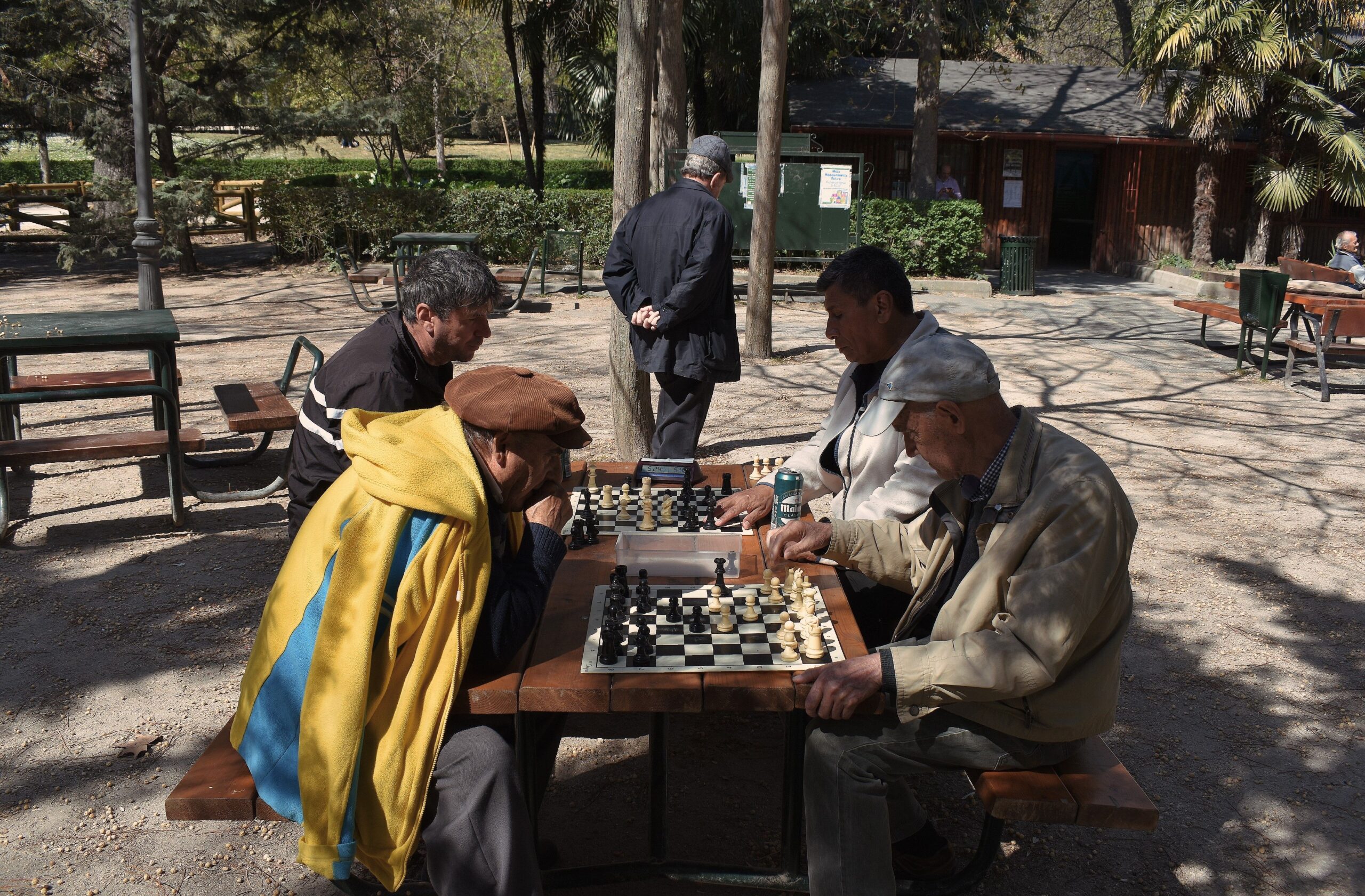
96: Chess is easier when you can see the board
I’m writing about 100 things I’ve learned the hard way about product management. You can catch up on the previous entries if you like.
A Wardley Map is to corporate strategy what a chessboard is to players: you can absolutely play the game in your head without seeing the board, but if you can see the board it’s a lot easier to play, and you have a massive advantage over the people who can’t.
Just like a chessboard, the purpose of a Wardley Map is to help you visualise the relationships and relative positioning of the ‘pieces’ in order to see what the current state of strategic play is, and what possible and sensible moves are available for you to make next within the rules of the game.
In this article
In maps, position matters
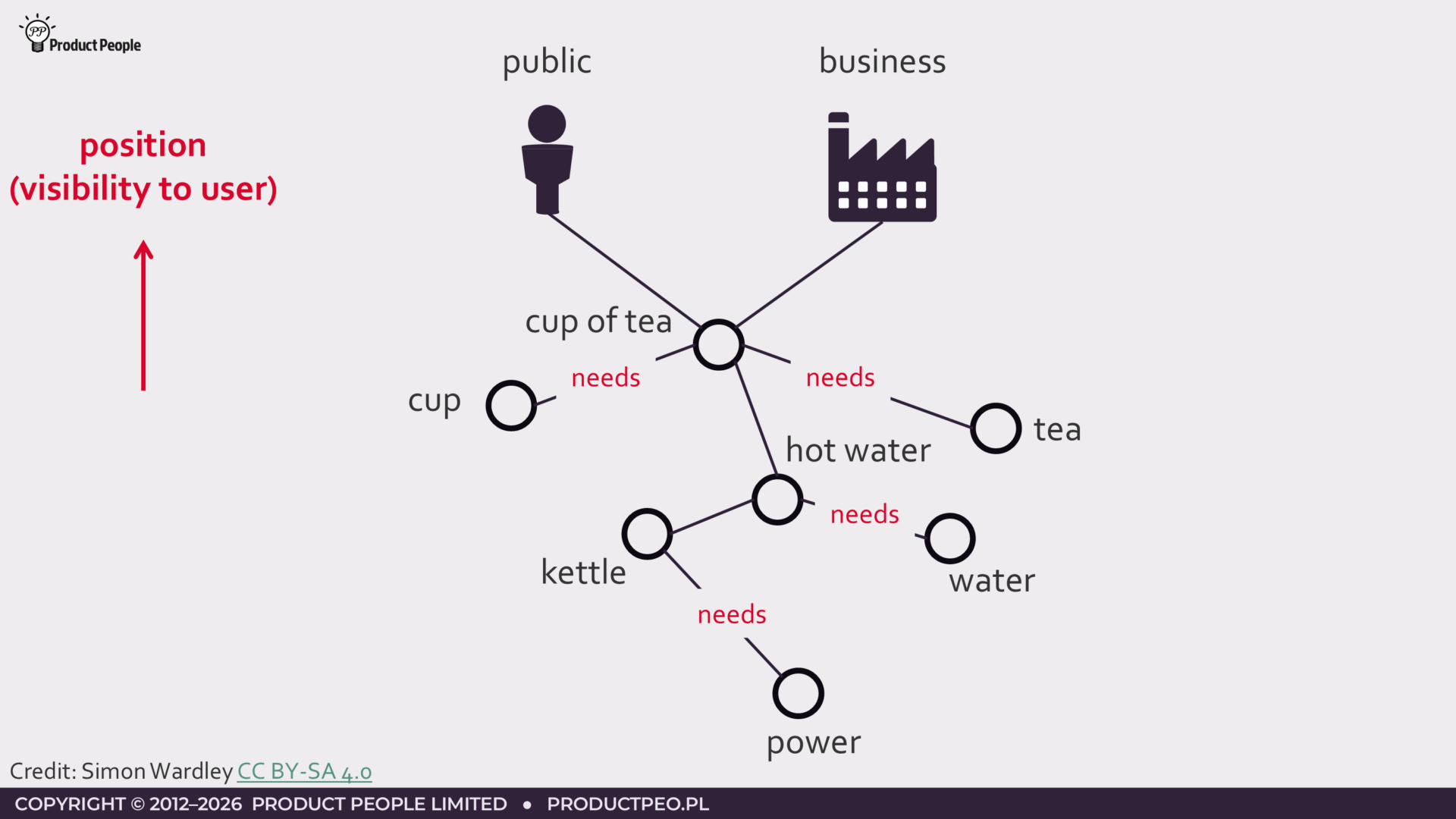
Instead of chess pieces, a Wardley Map shows the positions of things such as the components of a product or service. As a simple example, think of a tea shop needing teabags, hot water, cups and milk as a bare minimum to be able to serve cups of tea to customers.
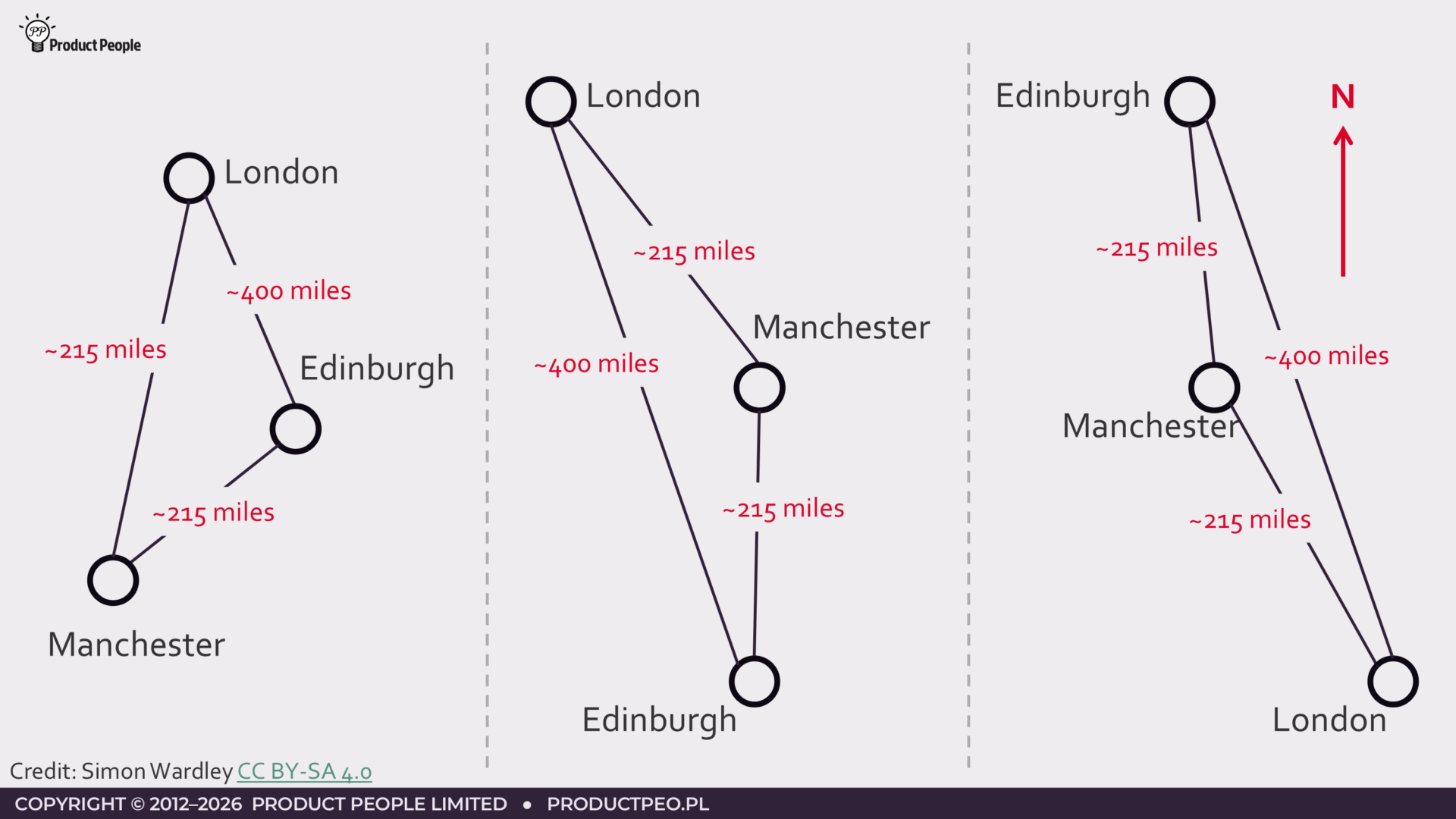
For the Wardley Map to be an actual map (where relative position matters), not a graph (where it doesn’t) it needs a fixed point of reference called an anchor. On geographical maps, you’ll always see a compass showing where north is. Without that it would be impossible to say definitively that Edinburgh is north of London because we wouldn’t know how the map is rotated relative to north. Likewise with a Wardley Map, we start with the user of the product or service as the anchor point at the top. With the user located, we know which way is up in our map.
We can then lay out the components of the product or service top to bottom based on their relative visibility to the user: the cup of tea is the most visible thing to the user so it is closest; the power used for the kettle to heat the water in order to make the cup of tea is far less visible to the user, so we position that much lower down. That’s one axis of the map.
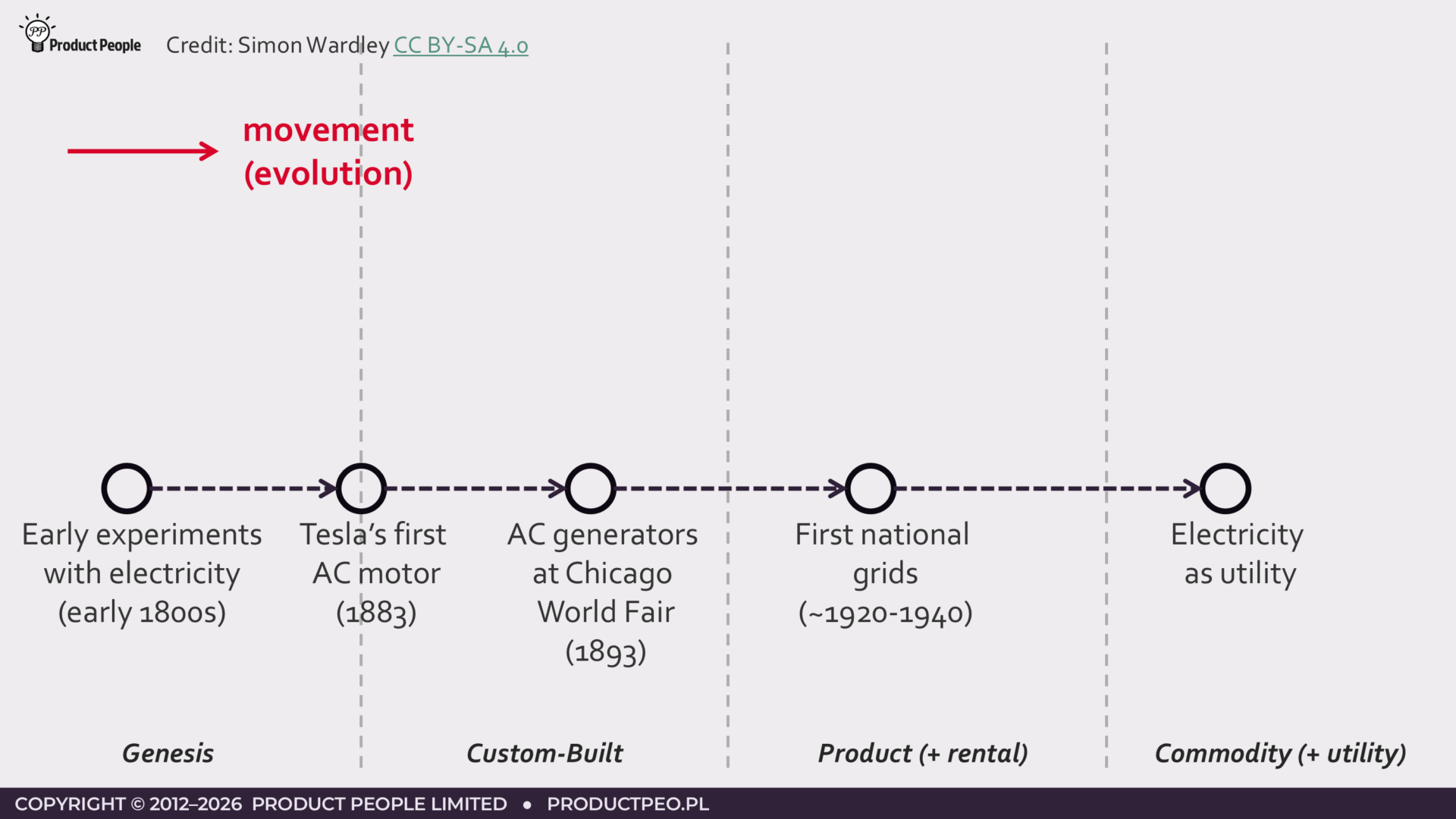
The second axis of the map is how evolved that particular component is right now. On the left hand side of the map we place things that are entirely novel. Towards the right of the map are things that have become standardised, commonplace, and widely available – commodities or utilities.
If we were creating a map of electricity generation in the early 1800s, electricity itself would be a novel concept, still the domain of pioneer physicists such as Michael Faraday and Georg Ohm. Later we might update our map to show Nikolai Tesla’s custom-built AC motors and the AC generators built to power the Chicago World Fair in 1893. By the 1920s and onwards, enough standardisation has occurred on power generation and supply that the first national grids begin to emerge. By the present day, electricity and its means of generation are commoditised to the extent that people (to generalise) have a constant supply of electricity that is billed by what they consume.
Rules of the game and gameplay patterns
Climate
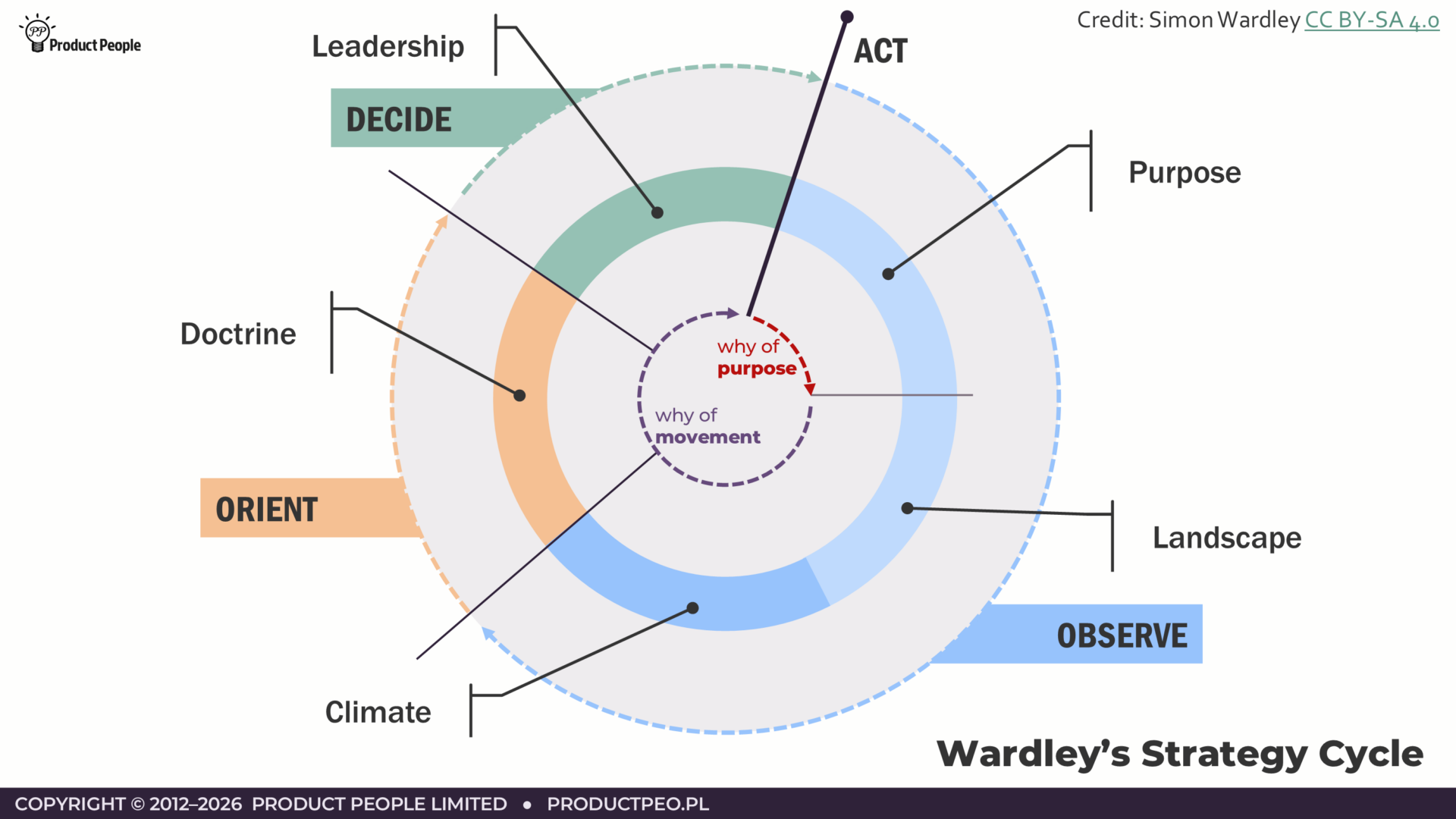
The evolution of electricity generation illustrates one of the inherent rules of the strategic ‘game’: everything evolves over time. It starts on the left when it’s novel and magical and moves to the right as it becomes more standardised and widely available. This type of rule is one that happens whether we want it to or not. Wardley refers to these economic and competitive patterns as the climate. Just like the weather, they happen to us and we have to adapt our plans accordingly. ‘Everything evolves’ is just one of many climatic patterns identified by Wardley that can and will happen whether we like it or not.
Doctrine
Another set of patterns are what Wardley describes as his doctrine. These are a collection of types of strategic gameplay. Unlike other moves you can make, this set can be applied universally regardless of the product or service, its components, or the competitive context in which you’re operating. Also unlike climatic patterns, you can choose whether to apply them. ‘Focus on the user need’ is an example. To many in the product profession, this is a default move, yet it still remains a choice. A purpose of doctrinal patterns (or moves) is that they enable and encourage discussion: if we’re not focusing on user needs, why are we choosing not to? If we’re not distributing power and decision making (another pattern), why are we not?
Wardley created this list of doctrinal patterns based on his own experience over the years. If you wanted to, you could create your own doctrine based on the patterns of strategic gameplay you’ve observed to be universally applicable and use that instead, although I suspect you’d probably come up with a similar list.
Gameplay
Lastly there are gameplay patterns that, unlike doctrine, only make sense in particular contexts. Again, you have the choice over which moves you want to make. If you’ve ever played chess either by mirroring your opponent’s moves or by blindly carrying out a set of moves regardless of what your opponent is doing, my guess is that you’ve seen how quickly they catch on and manipulate you into losing.
Companies often fail because they simply copy the moves another successful company has made, either by aping a competitor (their context is different to yours) or by bringing in a consultancy with a playbook (a pre-defined set of moves) but no visibility of the ‘chessboard’ (the landscape and how it’s changing).
Iterative loops
Once we start mapping out our own products and services, we can also map out how competitors are playing the game. In chess, good players don’t set out with a game plan in mind and stick rigidly to it regardless of what the other player is doing. They observe each turn how the pieces on the board have moved and adapt their gameplay accordingly to either counter or take advantage of the other player’s moves. However unlike chess, competitors don’t take turns in strict rotation, so we need to keep re-evaluating how the map has changed given that we and our competitors are all making moves, and that climatic patterns are also forcing changes upon us.
This creates an iterative loop in which we observe (gain situational awareness and context of which pieces are on the board, where, and how they’re moving), orient ourselves (by making sense of what we’re seeing with the benefit of understanding the rules of the game), decide which of the moves available to us is/are most beneficial right now in the context, then act by carrying out that course of action without delay.
Wardley borrows this OODA loop (observe, orient, decide, act) from US military strategist John Boyd. Each ‘turn’ we take around the loop doesn’t mean we have to rework our overall game plan from scratch each time. Rather we understand how things are changing and adapt our strategy accordingly, just as we would do each turn in chess to respond to our opponent’s move.
“All models are wrong, but some are useful.” (George E. P. Box)
We’re now able to locate components on a map, anchored to the user at the top, laid out top-to-bottom by relative visibility to the user, and left-to-right by how evolved each component is. We also know that over time the components on the left will move towards the right as they evolve. Just as with any other map, it is an abstract view of reality.
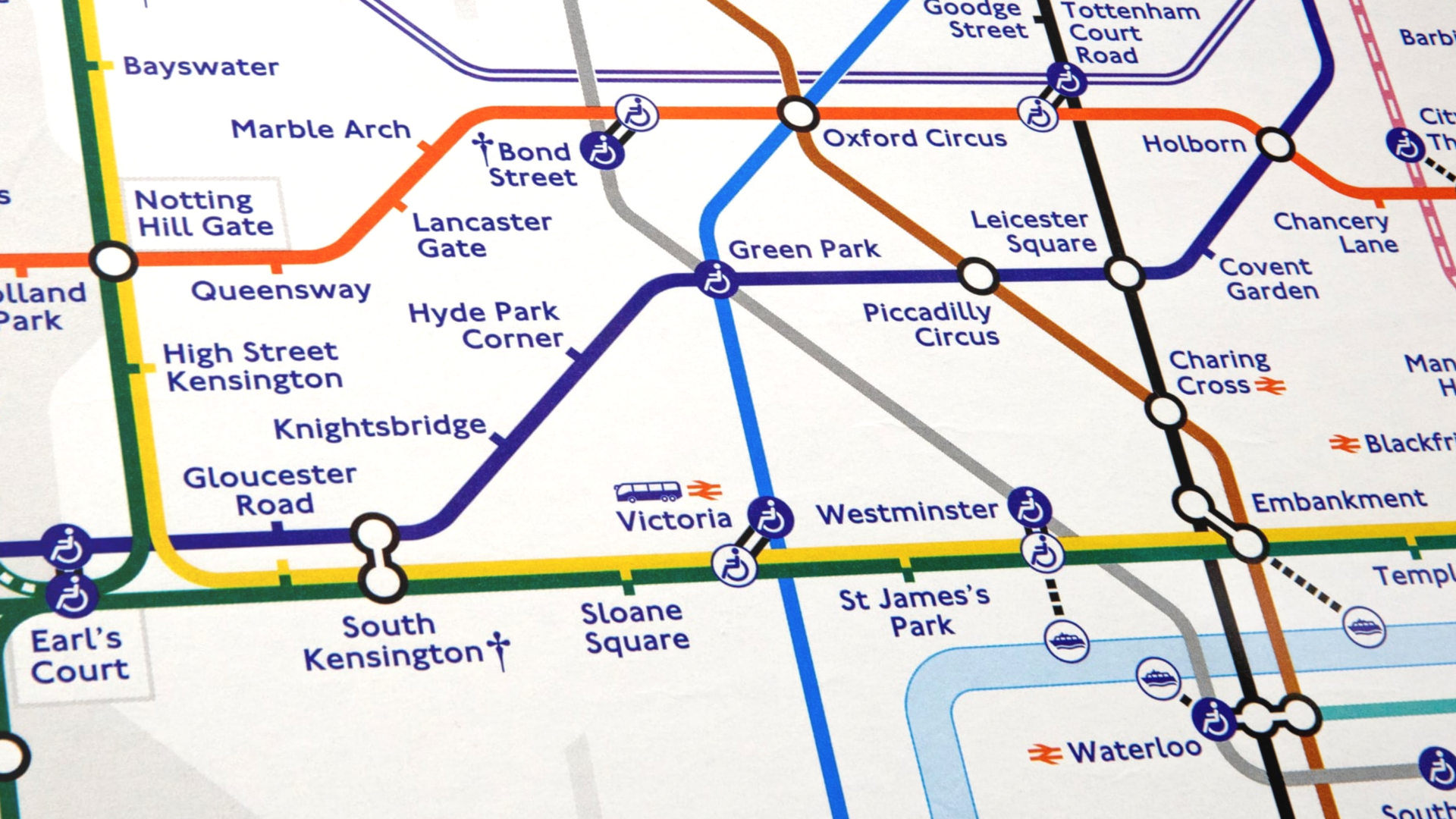
A map is not perfectly detailed or even accurate, nor does it need to be perfect to be useful. The famous map of the London Underground is designed to help you understand how things connect and how you can get around, but it’s infamous for being geographically inaccurate. A fully accurate geographical map would be 1:1 in scale and identical in detail to the area you were mapping, making it much harder to use.
Once we have a basic map of our tea shop, we can start to ask questions about details the map has made obvious. For some reason my particular tea shop has a number of peculiarities. We have a pottery and kiln round the back which we use to make our own teacups, placing them far over on the left in ‘custom-built’ territory. It’s tremendously time-consuming and costly. We should sensibly ask the question why on earth we’re doing all that when we could just buy some dirt-cheap ones from a wholesaler. One answer might be that the pottery is actually the main business, and the tea shop is primarily a means of showcasing the cups we make for people to buy.
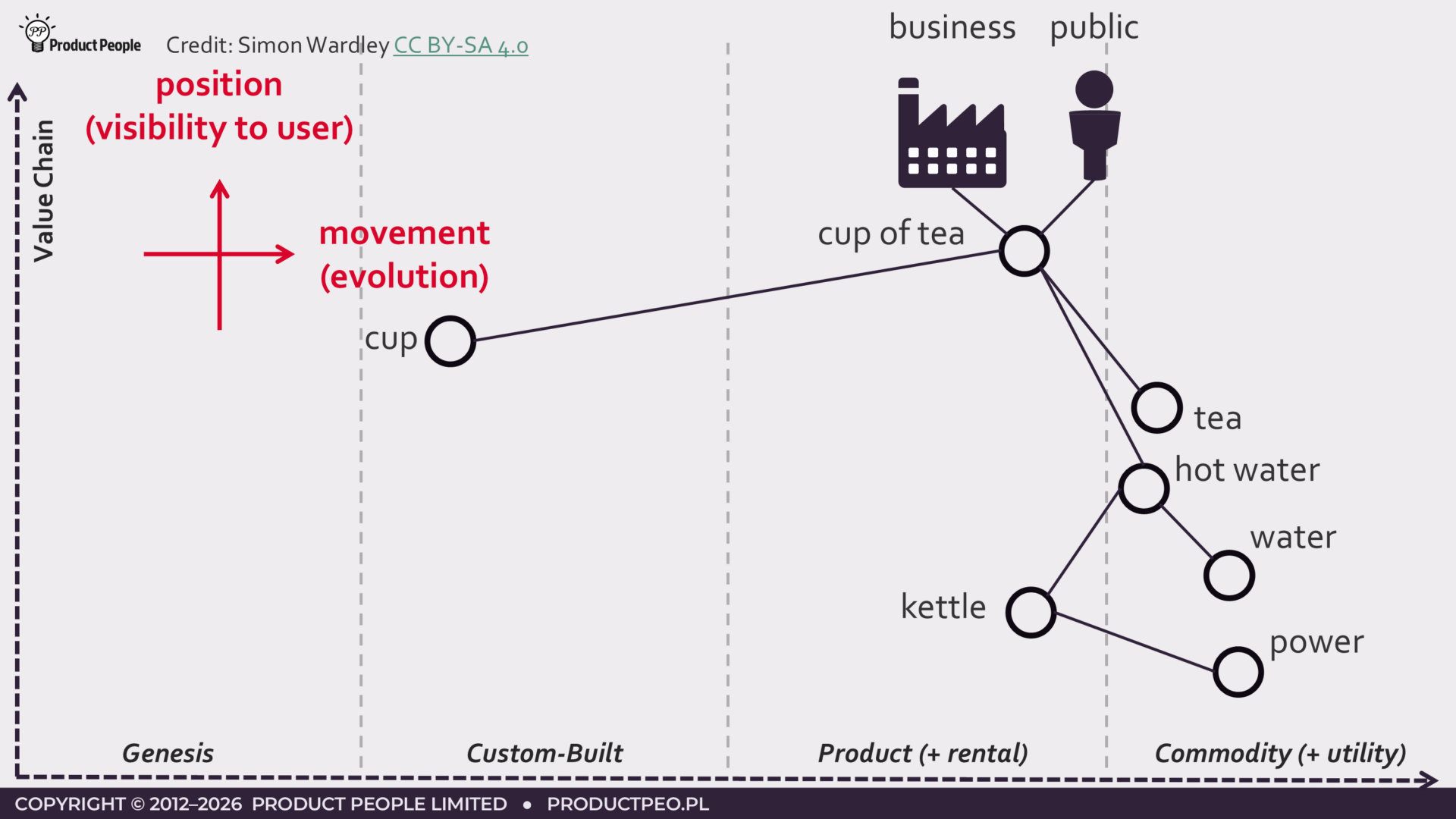
The map doesn’t necessarily say whether the moves we’re making are right or wrong, but by examining the map we can challenge whether what we’re doing makes sense in the context.
Final thoughts
Your strategy is a combination of the choices you’re making about where to play and with which pieces. While there are some general rules governing how the climate changes around you, it is up to you to decide on the moves you want to make, when and how. Rather than making up moves or copying other players’ moves blindly, creating a Wardley Map helps you to understand the competitive landscape and your position within it, and makes the better choices of gameplay more obvious to you. As with any changing situation, we need to iteratively re-evaluate what’s changed and why before deciding what move to make next.
Further reading
Simon Wardley’s official Wardley Maps website
Another useful Wardley Mapping website
‘Chess in Business‘ – Simon Wardley
‘A good enough map‘ – Simon Wardley
‘Doctrine, Climate and Context Specific gameplay‘ – Simon Wardley
‘Wardley’s Doctrine‘ – Simon Wardley
‘Climate‘ – Learn Wardley Mapping
‘Chapter 3: Exploring the map‘ (climatic patterns) – Simon Wardley
‘Doctrine‘ – Learn Wardley Mapping
‘Chapter 4: Doctrine‘ – Simon Wardley
‘Leadership‘ (contextual gameplay choices) – Learn Wardley Mapping
‘Chapter 5: The play and a decision to act‘ (contextual gameplay) – Simon Wardley
Read more from Jock
The Practitioner's Guide To Product Management
by Jock Busuttil
“I wish this book was published when I started out in product management. It gives a really wonderful overview of what product management is and involves on a day to day basis.”
— Keji Adedeji, product leader & coach

Jock Busuttil is a product management and leadership coach, product leader and author. He has spent over two decades working with technology companies to improve their product management practices, from startups to multinationals. In 2012 Jock founded Product People Limited, which provides product management consultancy, coaching and training. Its clients include BBC, University of Cambridge, Ometria, Prolific and the UK’s Ministry of Justice and Government Digital Service (GDS). Jock holds a master’s degree in Classics from the University of Cambridge. He is the author of the popular book The Practitioner’s Guide To Product Management, which was published in January 2015 by Grand Central Publishing in the US and Piatkus in the UK. He writes the blog I Manage Products and weekly product management newsletter PRODUCTHEAD. You can find him on Mastodon, X (formerly Twitter) and LinkedIn.
