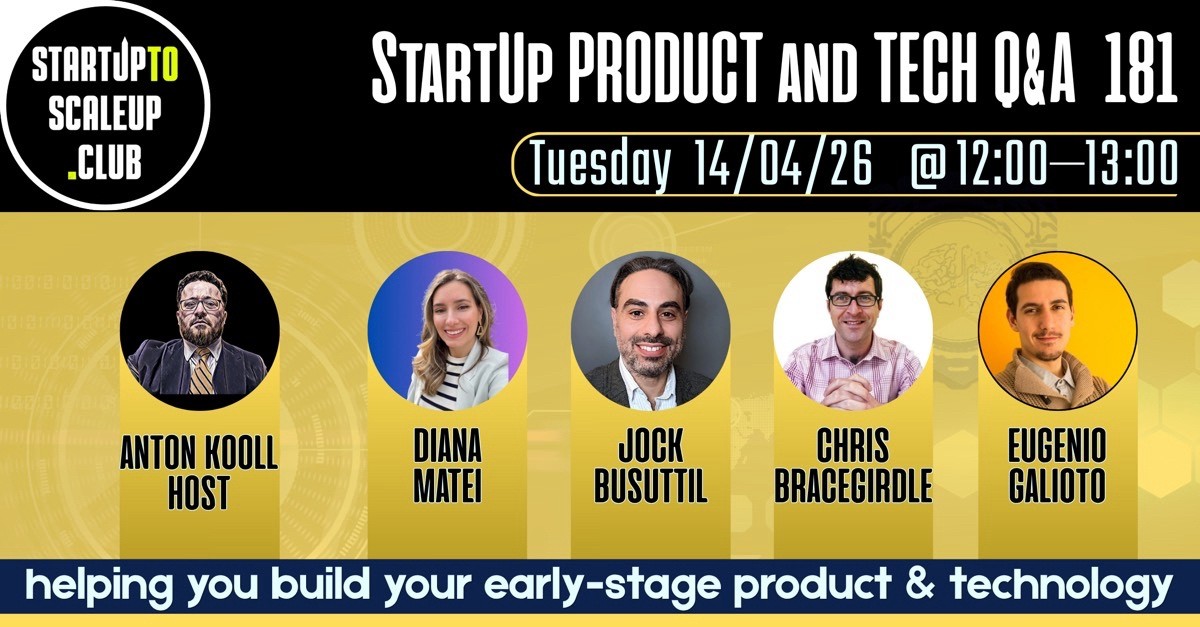
Startup to Scale-up Club Q&A – 14th April 2026
For Startup to Scale-Up Club‘s Product and Tech Q&A in April, I joined Anton Kooll and co-panellists Diana Matei, Chris Bracegirdle and Eugenio Galioto. Together, we fielded questions on product and technology from startup founders looking for advice.
In April’s session, we cover topics including:
- Structuring analytics for user engagement
- Defining an MVP in the AI era
- When to use genAI and when to use machine learning (ML)
- Product differentiation in a crowded market
- Implementing reusable components and designs
Have a listen below! Transcript available below.
Transcript #
[Anton Kooll] (0:00 – 3:45)
Good afternoon everyone, thank you very much for joining us. This is Startup Product and Tech Q&A. We’ve had a few of these now, I believe it’s our 181st session.
We’ve started these about five years ago. In that time we’ve had at least 290,000 people that have tuned into these sessions where we’ve answered at least 3,000 questions from founders and none of that would have been possible without people like Diana, Jock, Chris and Eugenia. So if my brilliant panellists would like to drop some, maybe a LinkedIn URL and also a couple of words about what is it you do for startups, that would be great in case anybody wants to reach out to you.
On the other hand, we’ve recently changed our model from doing weekly sessions to now doing a monthly session instead. Basically the way that works is on the second full week of each month we run something called Startup to Scale Up Week where we cover the six most important and vital points of one’s journey from startup to scale up. So on the Monday it’s Tylan helping you hire and keep the right people.
On Tuesday, as you can see today, it’s Product and Tech helping you with anything, let’s say from product roadmap, to testing, to prototype, to design, landing pages, apps, testing, MVP, automation, AI, full stack, tech debt, loads of no code and all that jazz. And then tomorrow on Wednesday, it’s growth. On Thursday, it’s fundraising.
And then these are all from 12 to 1pm UK time. And then on the Friday, we’ve got two sessions at pm, it’s UK startup law. So we get a few lawyers answering questions.
And then at 1pm, it’s UK startup finances with some accountants and CFOs. They’re all free, they’re all audio only here on Microsoft Teams, which means you can tune in and join us from anywhere via any platform or device. Now the way this works today, it’s quite straightforward.
We’ll have some quick intros, then I’ll be asking my amazing panellists for a do and a don’t when it comes to early stage product and tech. And then we’ll be taking questions from yourselves. There are no wrong questions and there’s no need to be shy.
It’s a learning curve for us all. The best way to do this is you drop your question in the chat, we give you the mic, you introduce yourself, and then fire away with your questions. To make things a bit more interesting, I will be timing our answers to a minute each.
I will also post questions that were sent in and a ton of questions were sent in from founders into the chat. With most of these questions, I’m going to put them through ChatGPT to help me reformat them a little bit. They’re not sufficient in terms of the information that one needs.
So if you think ChatGPT and myself have changed your question, then please do bother to join us live, where we’ll be more than happy to go through what you need right now to build your early stage product and tech right. So without further ado, my name is Anton Kooll. I’m an Albanian in London working with startups normally right after they get investment.
I embed within their teams and help them hire and keep the right people. I also do some growth advisory work with a few other startups and accelerators and help some angels and family offices with their due diligence and assessments.
[Diana Matei] (3:45 – 4:13)
Hi everyone, I’m Diana. I’m a product consultant and I work with scaling businesses, but also startups. I mainly work with founders and I help with commercial strategy, pricing, business model, and trying to find the right journeys that actually track business metrics.
So the discrepancy between what features are we building and the impact these are having against bottom line for the business. Decade experience working in travel, e-commerce, in tech.
[Jock Busuttil] (4:13 – 4:53)
Hello everyone. My name is Jock Busuttil. I’m a product management coach and consultant.
I run the company Product People Limited. And I’ve been working in product for about 20 years with a variety of different sizes and shapes of companies and different market sectors. I’ve done a lot of work with startups and founders, particularly on the coaching side, where they are effectively the product person in their organisation.
So I’ve been helping them adapt and work with that. But also I’ve worked hands-on in many startups, particularly as they start to grow, start to build out their product practice so I can help with that. I also write a lot about product management and I publish it all for free on my blog at imanageproducts.com.
[Chris Bracegirdle] (4:54 – 5:29)
My name’s Chris Bracegirdle. I am a technologist, an entrepreneur. I’ve built and sold various different technology businesses, including a data analytics business that was sold to Rightmove.
I’m currently running a voice AI business. On top of that, I do various consultancy projects for various clients. I’m a machine learning PhD and I’ve been doing AI and machine learning since before it was everywhere.
Yeah, I’ve built and designed lots of different platforms and systems and products. And I can’t wait to get to answering some of your questions. Thank you very much.
[Eugenio Galioto] (5:29 – 5:52)
Hi, I’m Eugenio, fractional CTO and AI transformation coach for executives and SMEs. Currently, I lead tech teams across USA, UK, Australia, and Italy with relevant agentic applications in production, in fashion, and real estate. I’m part of elite communities like OnDeck and Entrepreneur First and co-founded startups in Europe and the Bay Area.
I’m here today to improve your way to be impactful as a person and as a company.
[Anton Kooll] (5:52 – 6:14)
Wow, we’re on fire today. Well, thank you very much. This is absolutely brilliant.
Well, we’re only going to be here until 1pm. So my advice to those of you here, if you’ve got any questions or need some clarity or help from our amazing panellists, drop your question in the chat ASAP so that we can do the rounds and give you the mic. Until then, let’s hear some do’s and don’ts.
[Jock Busuttil] (6:14 – 7:04)
Do is do remember to go out and actually speak to real people about the problem you think you’re trying to solve rather than relying on synthetic users or asking ChatGPT all the time what you think it should be doing. The main reason for that is as you’re increasingly reading, there’s a lot of bias in what’s coming back. It’s sycophantic.
Potentially, it’s going to give you the answers you’re looking for. So to combat that, go speak to real people. On the don’t side of things, don’t forget to keep your customer support human just because you can put it through a chat bot doesn’t mean it’s necessarily providing the quality of service you want, particularly your early adopters and first customers are going to be your referral customers to receive.
So keep it human on the customer support interactions. Thank you.
[Chris Bracegirdle] (7:05 – 7:48)
Thanks, Jock. Yeah, so I’m going to start with a don’t and this is one of my pet don’ts. Don’t build components that you can easily get off the shelf.
You should definitely focus on the core IP that you’re developing, the core value add that you’re offering and not role customized solutions for very, very common problems. And I see that happen all the time. And in terms of do, do try and test that you’re solving a real problem and not just something that you think is a problem that people out there have.
And this is the challenging bit and I get real users involved as soon as you can. But it’s very, very important that you test and I use that word carefully, that you’re solving a real world problem that other people have.
[Eugenio Galioto] (7:48 – 8:30)
Thanks. So on the do, I would say think of yourself not anymore as a specific person with specific skills and a specific job function and start instead thinking of yourself as a serious collection of job functions. Primarily because with AI, we can now extend way beyond our past experience, which means that that kind of person can become a marketing person and so on.
And so the key point is about a collection of job functions that now is possible to enable with AI. And on the don’t, don’t leave assumptions unchallenged. Try to challenge your assumptions very soon in order to save a lot of time in your journey.
[Diana Matei] (8:30 – 9:20)
So my do is to actually build an audience first before you even have a product. It’s becoming a lot easier to build features, but it’s a lot harder to differentiate. And by having an audience that you already know what their needs are and you already have a confidence that they would buy from you or that they would actually buy the product you’re building.
And that’s the biggest key area. The second, which is don’t, kind of linked to this, but is more around the fact that a lot of time we’re building tech, but we’re not thinking how is it actually going to make money? Because, especially when you’re dealing with AI, it’s quite cheap to build the first version, but it gets a lot more expensive as you’re scaling it.
A lot of people leave the pricing strategy towards the end when actually it should be embedded with why should I build this in the first place? And how would I make money? It’s kind of going back to business basics, to be fair.
[Anton Kooll] (9:20 – 9:55)
Thank you very much to all four of you. This time we get on to some questions. She says, I’m leading a prop tech startup in Glasgow with a rental management platform.
We want insight into which tenants engagement features matter the most. How would I go about structuring our analytics to capture meaningful data on engagement without impacting the user experience? This is something we often get to be honest with you.
It’s not always easy. Actually, it’s often quite hard for founders to get this right.
[Chris Bracegirdle] (9:56 – 10:44)
Thank you. This is a very common problem and it speaks to a bit of a conflict, really, in how you do search around what features people actually want. So on the one hand, you could say, well, we’ll create some UI for those features.
And then if people tap on it to say, I’m sorry, this is coming soon. But as the question implies, that’s in many ways a rubbish user experience. You could do Figma-style mock-ups and prototypes and show those to people in research sessions.
The problem with that is you’re not getting data at massive scale. So those are sort of the two extremes of how you might address this question. But neither of them really answering what you want, which is grand scale analytics.
And a third way is to have a very neat effectively survey feature in your app that asks people, are they interested in this feature at this point? But yeah, I think it’s a very difficult problem to solve. Thank you.
[Eugenio Galioto] (10:44 – 11:35)
Well, the first point about the question is that how to capture meaningful data on engagement without impacting the user experience. If I’m not understanding wrong, this should not impact the user experience anyway, because you’re tracking data. Possibly what you want to create is a series of assumptions on the flow that you think people will follow, maybe in terms of user stories or steps, and you try to measure the success, the frequency of these steps potentially by using, of course, existing tools.
And maybe you can create new assumptions and try to make small changes at a time to see, maybe tests or similar, to see if your assumptions on the flow work. In the end, the best users say these are the ones that are lazier because they can perceive the friction of going from one place to another. So maybe even listen to them if they want to participate.
[Diana Matei] (11:35 – 12:38)
Especially when it comes to engagement, I always come back to what hypothesis do you have? So be really, really clear because it’s really easy for everyone to put surveys or to impact the user journey at different times. And then the clearer you are with the specific hypothesis, then you’ll be able to put the right engagement.
But if you remember, Amazon now asks you for so much feedback across every single touchpoint, and then everyone’s tired of giving feedback. So the best way would be to maybe even fast segmenting your customers, identify the ones that are loyal, and then understand why is it that they like about it, especially if it’s engagement. So if you want to get more people to become your ideal customer profile, I think it’s a mix between shorter tracking in the platform in terms of more steps or what features they’re using, but then go for the extremes.
Who’s using your platform the most? Go talk to them. Who’s using your platform the least?
And then identify the drop-off points. Is it in onboarding? Is it the first 90 days?
So try and create different problems around the engagement and then be specific.
[Jock Busuttil] (12:38 – 13:25)
I would say think about what you define as mattering most. It’s going to be subjective, and it’s going to change as you go through your startup process. Figure out what your biggest problem is right now, and figure out how you can set about testing it.
These are the hypotheses that Diana was talking about a second ago. The second thing is whenever doing any kind of analytics on this kind of thing, remember to balance your qualitative and your quantitative. Your quant will tell you what’s happening.
Your qualitative will tell you why it’s happening. And so what you’re going to have is this kind of figuring out something interesting in your data, and then going talking to people to figure out why it matters to them and what the problem is underlying that. So think about getting that holistic view and figure out both the what and the why.
Fundamentally, if you want to figure out what matters to people, you’re going to have to talk to them in some way. Surveys aren’t necessarily the best way of doing it.
[Anton Kooll] (13:25 – 13:49)
Thank you very much to all four of you. This time we go on to another question. By the way, if anyone here would like to ask our panellists anything, please simply drop your question in the chat.
We’ll give you the mic, introduce yourself, and then fire away with your question. There are no wrong questions and there’s no need to be shy. It’s a learning curve for us all.
[Priyanka] (13:49 – 14:52)
I’m Priyanka, and I’m building a marketplace and B2B SaaS platform in the hospitality sector to help event organizers discover book spaces and manage those bookings. We are currently in pilot stage, so we have tied up with two venues who are using our SaaS platform, and we have paid customers in terms of event organizers using our marketplace to book spaces. So my question is about an MVP.
We are still early stage, but in an era where it has become really easy for us to use the available AI tools to build, how should startups think about their MVP without really getting into the build trap? And related to that, a second part of the question is how do we define MVP in an era, again, of where it’s so easy to build, where users just demand a lot in terms of a good experience, but it just means that we are no longer in the MVP stage and we end up building a full product, but that’s the whole point that we shouldn’t be doing it out of good practice and test and learn and iterate with the very basics.
[Anton Kooll] (14:52 – 14:59)
That is a brilliant question and a very, very telling one about where we are right now, Priyanka. Thank you very much for that.
[Eugenio Galioto] (14:59 – 16:24)
The MVP concept started when tech was hard to build and you needed to prioritize because otherwise the cost would have been months of useless development. So it’s not necessarily a rule, it was a necessity. Now we have abundance of intelligence and of coding skills, let’s say, but the key principle of the MVP is not about the tech, it’s more about the effectiveness of the business.
So the key point is that if you’re unsure about where the value is with your customers at the moment, what they are very happy to pay for and what else they may be happy to pay for, that’s the primary focus. So since there’s a lot of AI coding agents, you don’t want just to add the features, but you want to iterate on the existing ones, few ones, to make sure you validate the business first. In terms of workflows, you shouldn’t at this stage ever compromise on the user experience because now with AI agents, you have the chance to create literally hundreds of variants of your website with the tens of agents that work in parallel.
So I think this part in the MVPs is often ugly because you don’t have the money to pay a designer maybe, but now you can create many variations of the same UI, for example. So that’s where I would spend some time on. And in general, keep the product simple, regardless of the fact that you can add a thousand features at a time.
[Diana Matei] (16:25 – 17:38)
Definitely a really interesting challenge and it depends on the conversations you’re having with customers because now everyone is aware of what technology can build and there’s a fine line between the product solving their current challenges and doing a really good job for the specific needs they have, really categorizing the different needs that they want to go for. A lot of times people jump into personalization or being like, oh, I would like this to be as specific as it is to me, but actually that doesn’t mean it would solve their problem better. And another angle to this is make it as clear-cut or as best of a match between what you’re building and the audience is to be very clear on the ICP.
So obviously with events, there’s loads of different personas or loads of different people that have a variety of problems. So it’s like the more you kind of like restrict who you’re actually targeting, the more specific you are, then the chances are that these are going to be like more similar. So when you’re building features, they’re going to be a better match.
A lot of times, like when you talk to a variety of people, even though in the same area, you end up focusing on adding features for different types of people. Ask for what problems they have rather than what features they would want.
[Jock Busuttil] (17:40 – 18:42)
Hi Priyanka. So MVPs have been debated for 10 years plus, ever since Eric Ries wrote about them in The Lean Startup. The way I always explained it to people, even before it became really easy to build stuff with AI, is that an MVP is just another way of learning.
It’s a higher fidelity prototype. It’s a higher fidelity experiment. And the purpose of an MVP, like anything else, is just to be able to get some useful learning about what works, what doesn’t work, which tells you something about either the problem that your users are having, or about how well your solution addresses that problem for that group of users.
So it’s just a means to an end to learn. And so really, you can almost kind of forget about the MVP terminology and just say, how can I learn quickly, cheaply, easily, and as frequently as possible, so I can reduce the high level of uncertainty that I always have at the beginning of this process of building a startup. So don’t get hung up on MVP, treat it as an opportunity to learn something valuable that you can act upon.
[Chris Bracegirdle] (18:42 – 19:33)
You’ve received a heck of a lot of great advice there, Priyanka. Yeah, I think Jock’s nailed it for me. The MVP is really about learning.
And what’s great about the modern era of agentic AI is that we can do that learning at a hyperscale compared with what we can do before. And the advice that you receive from Eugenia around having a really, really good UI, which you can develop extremely quickly using tools like Lovable, which I’m a huge fan of, and then marry that with advice you’d get from the lean startup around learning manual processes around things such as, for example, payment, which you mentioned in your question. It’s about showing that you can get people to engage with it and showing that you can learn what users want.
Use modern tools to get very rapidly developed prototype out there and use offline manual processes to deliver for those initial users.
[Anton Kooll] (19:33 – 20:34)
Thank you very much. I try not to chime in too much, but the way I would look at this, Priyanka, and the way I today see MVP is a marriage between what your unique value proposition is, why you want to do this in terms of what would set you aside from what’s out there in the market, basically. Find the one thing that does it.
Whether you want to call it a feature or a setting or a task or whatever it may be, you’ve got to be able to do that with your MVP. And the other side of that marriage is, is that enough for people to actually pay for it? Once you’ve reached that point, I think you have reached the time where you can launch the MVP or whatever you want to call it.
Minimum viable product, a prototype, a usable product, whatever it can be termed, that is where I would try to aim. I hope you found this useful, Priyanka. Any follow-ups, anything else that we can help with?
[Priyanka] (20:35 – 20:48)
Thank you so much. All of that made a lot of sense. And then some bits of it we are already implementing, something that Chris talked about in terms of payments, for example.
It’s very helpful to get sense of how the current thinking around MVP is. Thank you.
[Anton Kooll] (20:48 – 22:17)
That is brilliant. Thank you very much. Right, team.
Unless anybody’s got more to add to Priyanka’s question, we can move on to our third question for the day. And we’ve only got 26 minutes to go. Only time for a few questions.
If anyone else has got questions, please drop it in the chat. Don’t be shy. They can be on anything to do with product or tech, whether it’s products, roadmaps, designs, testing, all the way to MVP and beyond, front, back, office, full tech stack, whatever it may be, just type it in there.
We’ll give you the mic, introduce yourself and then fire away with your question. I’ll read now the third question. I’m the founder of an AI analytics startup in Bristol and our cloud expenses, oh yes, I’m seeing a lot of this, have increased significantly as we train models on larger datasets.
We’re using AWS, but I suspect our resource allocation isn’t optimized. Could you recommend specific techniques for cutting cloud costs, especially for GPU intensive tasks, and are there ways to schedule usage based on demand? Very good question.
If we can start maybe from a product point of view on this, Diana, please, and then we’ll go ahead with Jock, Chris, Eugenio. One minute each, and this time I’m going to be a bit more robust and cut it at the top of the minute.
[Diana Matei] (22:17 – 22:44)
It’s a lot harder to know how you would architect the solution to consume less cloud. It comes back to how easy it is to build features and being on top of checking what is actually being used, what features are just added for nice to have versus the things that actually contribute towards the outcome of what your customers are trying to achieve. Just be a lot more careful and monitor what’s actually adding to the journey.
[Jock Busuttil] (22:44 – 23:15)
From a product perspective, this ties into your business model and basically does it make sense to be spending the amount of money that you are doing to receive the kind of information or make the progress for the product that you’re trying to do. I would always ask the question, at what point does the cost of cloud become offset by just buying your own kit and running indoors, albeit more slowly? Consider whether there’s potentially some on-premise solution that you might want to go to in the future if you anticipate your usage going up significantly in the future.
[Chris Bracegirdle] (23:15 – 23:59)
In general, I’m a huge fan of serverless environments as opposed to anything more tenuous, but it will depend on your exact use cases to which you’re using. I would highly recommend the various infrastructure as a service platforms. I really like SST or Pulumi, but I think your specific question about pricing is actually quite difficult to manage.
You need to decide between doing it right now versus scheduling it for when the price is low. Now, what there isn’t is a very easy way of saying, okay, we’ll do it when the price drops to x. The best you can do in a simple manner is to schedule your tasks for when you expect the price to be low and enable you to use EventBridge to run it at specific times in specific windows.
That’s the general approach.
[Anton Kooll] (23:59 – 24:05)
I’m liking this. That’s quite an interesting way to time it. Thank you, Chris.
Eugenio?
[Eugenio Galioto] (24:06 – 24:34)
Recently, I compared various solutions for training or fine-tuning, and I think that the NVIDIA-managed offering is interesting in this sense because they allow you to spin up a GPU when you need it, and so to pay a predictable cost somehow. I don’t know if this fits perfectly with your use case, but generally training or fine-tuning is something that you don’t do every time. Possibly, it can be fine for spot jobs.
[Anton Kooll] (24:34 – 25:48)
Let’s move on to our next question. Now, these are some of the newest or latest questions that we received in the last few days, and these have been put through ChatGPT to try and get a uniform format and submit. One of three co-founders at a seed stage health app startup in Manchester building software for remote patient follow-up after outpatient care.
Our small dev team is shipping quickly, and clinicians want new features, but releases are getting less predictable. Bugs are slipping through, and we’re arguing about whether more QA will slow us down too much. One thing I keep coming back to is that if quality drops, we lose trust with users, yet if we over-process everything, we’ll miss our next pilot window.
How would you recommend I approach balancing speed of development with proper quality assurance and testing in practice? I managed to find co-founders, and from what I can tell on their LinkedIn, none of them are techies, so that’s quite an interesting business to have with three co-founders who are not techies.
[Jock Busuttil] (25:48 – 26:49)
This is always fun because this affects any business at every stage, how you balance quality with speed of delivery of features. I think it is, as you kind of have probably figured out yourself, if you lose trust, that is the hardest thing to regain. And so you really need to look at the effect that these bugs and these quality issues are having on the experience for your users.
If you’re shipping something that doesn’t actually allow them to do the job they’re trying to use your software for, your product for, then they’ll simply stop using it because it’s not doing what they need it to do. And if you lose that trust that your product is sufficiently production ready, then they will start looking elsewhere. So I would say if it is becoming a significant, noticeable issue for your end users, focus on quality and scale back the speed of releasing features, and also understand which features maybe matter most so you can prioritize only the ones that are absolutely necessary right now and give yourself more time on the QA.
[Chris Bracegirdle] (26:50 – 27:34)
What I would try and do is think about your QA process here. How can you QA more effectively and use modern tools in that QA process? So what do I mean by that?
How much are you using test-driven development? How much are you using continuous integration testing to know when you write code that that code isn’t buggy? The final thing I would mention is we have access to some phenomenal AI tools now that can help you spot bugs.
So automated code reviews, Greptile’s very good. Sentry has a really good automated code review tool as well. So I’d just maybe take a week or two out, focus on your QA process, think about how you can do that better, and what are the tools you can use to try and head off some of these problems more easily going forward.
And I think you could probably do a lot better.
[Eugenio Galioto] (27:34 – 29:04)
So this is a problem at various levels and QA is just the top one. So it’s not the most serious one to be honest. I see it of course from both the experience as a as a fractional CTO leading teams and as a builder building stuff myself.
So the first problem is the development process because now you can ship features very quickly with Cloud, Coursera, whatever. And the main problem here is that the fact you can just write 10,000 lines of code immediately doesn’t mean that you’re doing it properly. So the very first point is to spend a lot of time on planning features and planning scaffolding for AI building to create these features.
And you will discover that even if you do the scaffolding, so very good scaffolding, like spec development and whatever, the coding agents are still able to introduce important schema changes or important technical debt. And you of course see only the tip of the iceberg of these problems because the truth is that they are compounding underneath in terms of problems that at some point would become way, way more difficult to solve. So spec driven development is the very first point here.
So being sure that when you create a new feature, you spec it properly without leaving any assumption by disambiguate as much as possible. And you can also have agents to test your implementation. The key point is that you should focus on the development process first and then add some QA later.
[Anton Kooll] (29:04 – 29:27)
Thank you very much. Right. We have got two more questions.
So Priyanka has got a follow-up, another question about incorporating AI agents and genAI tools in the product. What frameworks are used to know which use cases are best suited to use agents and genAI versus traditional ML, for example, when to build in-house versus piggyback on external tools. Brilliant questions, both of them.
[Chris Bracegirdle] (29:28 – 30:19)
Okay. So some great questions from Priyanka. So question was which use case is best to use agents and genAI versus traditional machine learning, for example.
And the answer to this one is what is the task, right? So if the task is about using numbers, I would use traditional machine learning because large language models famously are not good with numbers. They’re good at predicting what to say, but not that good at doing maths or doing much numeric without calling tools, and which is the same as using the machine learning tools yourself.
So I think for me, that’s the dividing line. So is it numeric? Then use traditional tools.
If it’s words, then use the LLM. And then when to build in-house versus piggyback on external tools, my general rule of thumb is if there’s a tool out there to do it at a sensible price, use the tool. You should only really be building things that are your core IP, your core assets.
And that’s just a general rule.
[Eugenio Galioto] (30:19 – 31:06)
In general, I would say that start with agents or with LLMs all the time. Just leave the traditional ML to very, very big problems that require it specifically. But consider that now the LLMs are very cheap.
So if you have classifications, estimations, whatever, you can use LLMs to create the traditional ML stuff. So you want to start with LLMs and maybe to simplify the problem first. And build in-house, I think it’s dangerous when you want to go fast because now tools and external sources are moving so fast that you risk to waste a lot of time building something that in the end is replaced the week after by a cloud plugin, for example.
So start looking outside and then maybe start building on your own.
[Jock Busuttil] (31:06 – 31:35)
Whenever you use an external tool, you’re bringing in many, many, many more hours of coding time into your organisation, which you would be starting from scratch with if you were to try build something yourself in-house. There’s also the other aspect, which is anything you build in-house has this tendency to become enmeshed with all your systems. And what was a two-day hack ends up underpinning your product for the next three years unintentionally.
So I just follow the advice of Chris and Eugenio here.
[Anton Kooll] (31:35 – 32:32)
We’ll move on to the next question. And the founder of an insurance tech startup in Belfast, seed stage, building software that helps brokers manage renewals and client follow-ups. We’ve got a product that works and solves a real pain, but I’m still trying to work out how to differentiate it in a market where several competitors already claim speed, simplicity, and automation.
What I feel is making this a bit tricky is that our edge could come from workflow depth, better onboarding, a narrower segment, or a strong service layer. And each option changes what we build next and how we position it. How would you recommend I approach differentiation in a practical way?
That’s interesting. Let’s start with Jock from a product point of view, and then Chris, and then Eugenio, please.
[Jock Busuttil] (32:32 – 33:28)
This is a lovely question. Something I refer to as the coffee shop problem, which is how can you have so many coffee shops on the same street, all seemingly serving the same product? How do they differentiate?
And the answer, which is also the answer I’d give to this person we’re helping, is to go niche. Focus on a very specific need you can cater to better than anyone else, and then focus purely on the segment that has that specific need. So in the coffee shops, some might focus on speed of delivery.
Some might focus on having lovely cakes. Some might have a really comfortable area for staying a long time in. Some might have additional stuff that allows them to differentiate themselves from their competitors.
So figure out what is the niche need that you can focus on that no one else is doing to the same extent, and absolutely max that out. And then what you’ll do is you’ll build up a very loyal fan base specifically who have that problem.
[Chris Bracegirdle] (33:28 – 34:11)
Thank you, Jock. Really good advice. For me, this is about testing different essentially marketing messages and finding the one that gets the greatest resonance.
And I’m definitely not a marketing expert, but there’s definitely ways you can do that. Putting up different landing pages, for example, different UIs, maybe testing those and seeing which one gets the most engagement. I suppose from a data-driven perspective, that’s what I would like to do.
It’s obviously reliant on you having enough traffic and enough interest to be able to get a meaningful signal from doing that. But yeah, I think this is about what’s your product positioning? How are you describing that to your customers and what’s going to get the most engagement and excitement?
There’s two points here.
[Eugenio Galioto] (34:11 – 35:11)
The first one is that you want to curate your positioning. Just this single word and concept is enough to solve most of the problems of your business. And when I say positioning, imagine that if you have two fast food places in the same street, let’s say McDonald’s and Burger King, you know that the McDonald’s positioning is for kids, while the Burger King positioning is for boys.
So this is very clear. It doesn’t need to be small. It just needs to be different.
And the second point is about how to reach the realization of your positioning. The best way to do it is to use the strategy canvas mentioned in the Blue Ocean book, which essentially is a graph where you have the competing factors on the x-axis and the investment levels in the y-axis. And you can track a blue line and the red line where the red line is your competitors and the blue line is yours, where you can actually be in a totally different shape rather than them and be appreciated for that.
[Anton Kooll] (35:11 – 35:42)
I think we’ve got time for one last question. I’m the co-founder of a retail analytics platform in London offering multiple dashboards for small business owners. Our lack of reusable components means adding new dashboard elements is quite time consuming and costly.
From a product perspective, how should we go about implementing modular components to speed up feature deployments and what steps can we take to ensure consistency across all parts of the platform? Quite a question.
[Jock Busuttil] (35:43 – 36:32)
It sounds like you’re potentially about to enter refactoring hell or heaven, depending on how you look at it. I would say from a product perspective, I would want to identify first of all, which are the things we’re doing most often and having to repeat ourselves most often. So that’s kind of, you know, seeing where the biggest problems lie.
Figure out what you’re doing most repetitively and either automate that or make it reusable. General advice applies to what I think you’re trying to do here with your modular components. In terms of actually implementing that underneath the covers, obviously this is going to be very subjective depending on the state of your code, but figuring out essentially where you can achieve that reusability through shared function, through … I’ll defer to Chris on this one.
He’s going to have more of a view on the actual implementation side. Thank you, Jock. Chris?
[Chris Bracegirdle] (36:32 – 37:26)
Thanks, Jock. Yeah, I definitely do have a view on that. So what you need are reusable components, no surprise to no one.
There’s a number of ways of getting reusable components. There’s a bunch of off the shelf libraries that you could run to, things like Mantine. You could rely on a consistent CSS approach, assuming you’re using React or similar, such as Tailwind, you may already be using that.
But what I would really suggest, if you’re up for the investment of development resource in it, is using a platform called Storybook and designing your own component library, which can be at whatever level of granularity you’d like. It will require you to invest, as I say, some effort in it, but you would end up with some reusable components that can be dropped in wherever they are and have a consistent look and feel. Storybook is a really good platform for that.
It allows you to render them in different situations, allow people to focus only on designing individual components effectively.
[Anton Kooll] (37:27 – 37:52)
What a session. This has been amazing. Thank you very much to all of you for tuning in.
Of course, huge thanks to those of you that sent in questions, especially those that were here live and asked questions live, like Priyanka. But obviously the ultimate thanks are to the amazing panellists who have given up their time to help us for free today. Before I let you go, it’d be nice to get some parting words.
[Jock Busuttil] (37:53 – 38:01)
Be more human. Don’t get too lost in the AI stuff. Remember to keep human connection, contact people, speak to people.
That helps. That’s probably it.
[Anton Kooll]
Good one.
Thank you, Jock. Chris?
[Chris Bracegirdle] (38:01 – 38:15)
I would just say what I always say at this slot, Anton, which is you’re doing hard work. Building something is hard.
Creating something from nothing is hard. Keep going. Give yourself a pat on the back and chin up.
Eventually, it’ll work.
[Anton Kooll] (38:15 – 40:14)
Thank you very much to all of you again. For my parting words, just a couple of quick reminders. We are now doing a Startup to Scale Up week with monthly events instead of the weekly ones.
The idea is that we are in a bit of a sprint on the most vital parts of a founder’s journey from Startup to Scale Up on the second full week of each month. On Monday, we have a Startup Talent Q&A. On Tuesday, as you saw today, we have a Startup Product and Tech Q&A.
On Wednesday, which is tomorrow, we have a Startup Growth Q&A, basically helping founders grow in your business and then selling to people. Then on Thursday, we’ve got Startup Fundraising Q&A. These are all 12 to 1 p.m. Then on Friday, we have two sessions. At 12 o’clock, we’ve got a session on legalities. We’ve got some lawyers answering questions from founders. At 1 p.m., we’ve got a session on finances with accountants and CFOs. Please do join them. We also have quite a community on WhatsApp. You can join various groups there.
Each of the sessions has its own group. You can connect with fellow founders, investors, operators, of course, our amazing panellists. So please do join that community.
I have just shared in the chat the link for tomorrow’s session, which is Startup Growth Q&A. As far as my part in words are concerned, just remember the startup journey can be both exciting but also quite challenging. So try to have some fun in the meantime and be kind to yourself and everyone else for that matter too.
Otherwise, again, hopefully we’ll see you tomorrow for Startup Growth Q&A. Thank you and god bless.
Read more from Jock
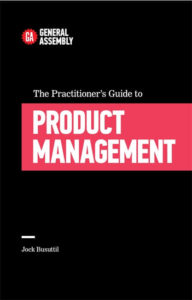
The Practitioner's Guide To Product Management
by Jock Busuttil
“I wish this book was published when I started out in product management. It gives a really wonderful overview of what product management is and involves on a day to day basis.”
— Keji Adedeji, product leader & coach

Jock Busuttil is a product management and leadership coach, product leader and author. He has spent over two decades working with technology companies to improve their product management practices, from startups to multinationals. In 2012 Jock founded Product People Limited, which provides product management consultancy, coaching and training. Its clients include BBC, University of Cambridge, Ometria, Prolific and the UK’s Ministry of Justice and Government Digital Service (GDS). Jock holds a master’s degree in Classics from the University of Cambridge. He is the author of the popular book The Practitioner’s Guide To Product Management, which was published in January 2015 by Grand Central Publishing in the US and Piatkus in the UK. He writes the blog I Manage Products and weekly product management newsletter PRODUCTHEAD. You can find him on Mastodon, X (formerly Twitter) and LinkedIn.
